Marketplace Sell API: Split Payments & Platform Fees
If you are evaluating Marketplace Sell API in 2026, this guide from SellAPI.com explains practical architecture, compliance touchpoints, and launch steps. You will see how Marketplace Sell API fits beside Merchant Account Sell API, Marketplace Sell API, Crypto Sell API, Solana Sell API, Ethereum Sell API, and Stablecoin Sell API—without forcing a rewrite.
Marketplace money movement explained
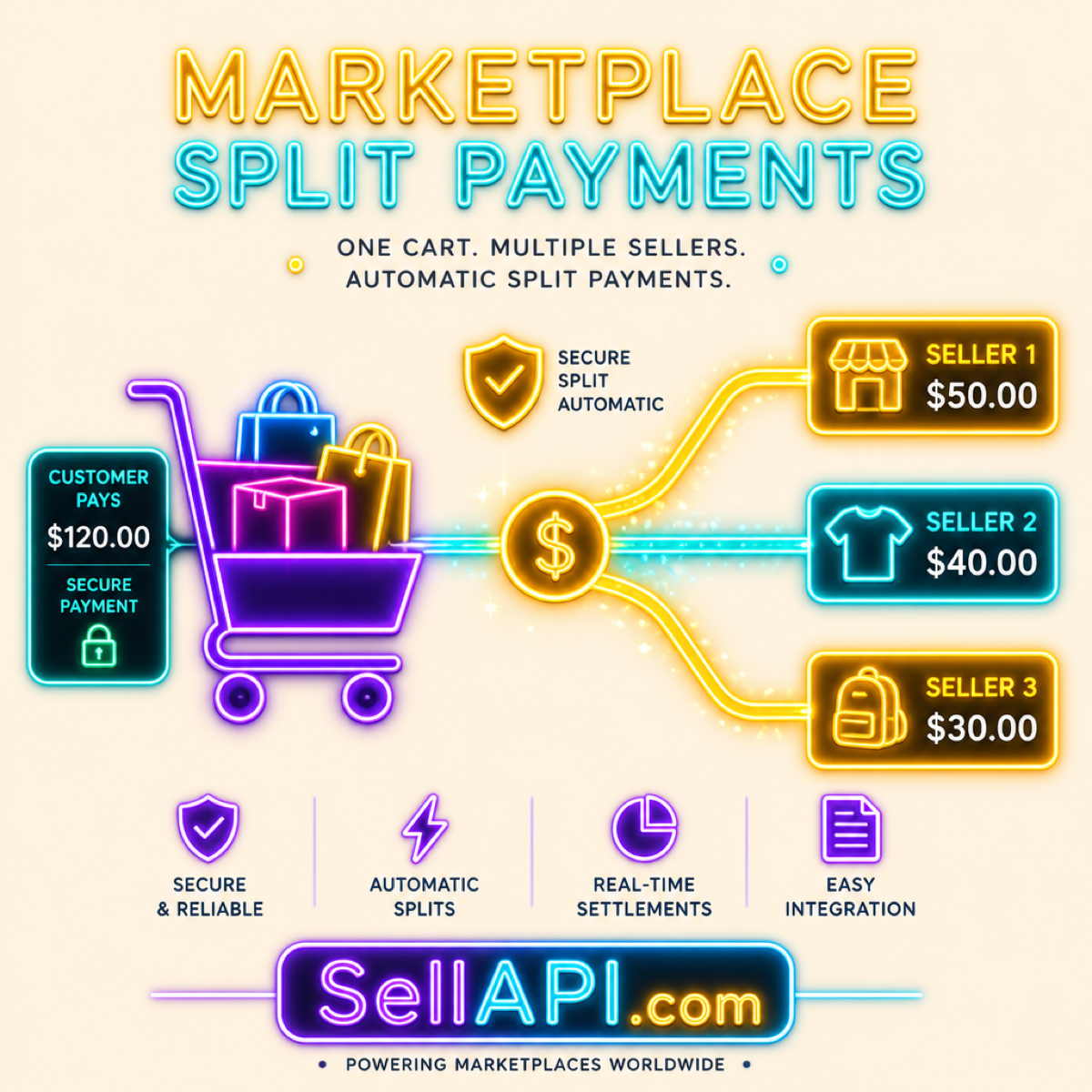
A marketplace takes a buyer payment and routes value to sellers minus platform fees. The Marketplace Sell API on SellAPI.com encodes that flow: charge once, split many, payout on schedule. Engineers search for split payments, connected accounts, and application fees—this guide covers each.
Separate the cart model from the settlement model. Your cart can be rich; settlement should be deterministic. Persist intended splits before confirmation so retries cannot double-pay sellers.
Combine Marketplace Sell API with Merchant Account Sell API so each vendor has a payout identity. Without merchant accounts, splits become manual wire nightmares.
Application fees and transparency
Declare application_fee_amount (or percentage rules) at sale creation. Show sellers estimated net in dashboards. Surprise fees create churn; transparent Marketplace Sell API economics create loyalty.
Handle tax carefully: decide whether fees are inclusive and who remits. Your ledger must reconcile Sell API transfers to invoices.
For digital goods or NFT checkouts, splits may include creators and affiliates. Keep participant lists versioned with the order.
Refunds and chargebacks in multi-party sales
Refunds may reverse transfers proportionally or hit the platform first. Document the policy. Use Marketplace Sell API refund APIs rather than ad-hoc ledger edits.
Chargebacks need evidence packets: delivery proof, communications, and KYC snapshots. Platforms that ignore disputes lose processing rights.
Wire dispute states into seller notifications. Pair with Sell API webhooks so your systems never miss dispute.created events.
Architecture patterns that scale
Use idempotency keys per order attempt. Queue webhook workers with at-least-once delivery and exactly-once effects via dedupe tables. These patterns appear again in our developers guide.
Separate read models: seller balances vs platform revenue. Nightly reconciliation against SellAPI.com balance transactions catches silent drift.
When adding crypto sellers, isolate crypto settlement UX—link Crypto Sell API and Stablecoin Sell API for rail-specific behavior.
Go-to-market for marketplace payments
Publish a seller help center covering payout schedules, fee math, and KYC. Internally link to SellAPI.com product pages for SEO and trust.
Pilot with a cohort before opening self-serve onboarding. Measure time-to-first-payout as your north-star activation metric.
Commercial details: see pricing. Partnership or security reviews: [email protected].
How Marketplace Sell API connects to the rest of SellAPI.com
Every module shares authentication, metadata, and event envelopes. That means your observability stack instruments one Sell API client. Homepage product pillars link here so visitors researching Marketplace Sell API land on actionable implementation guidance rather than thin marketing blurbs.
When prioritizing roadmap work, sequence sandbox mastery, then live Selling API charges, then merchant or marketplace complexity, then crypto rails. Teams that invert this order usually rebuild ledgers twice.
Bookmark the SellAPI.com blog index for updates, and subscribe via RSS to catch changelog-adjacent tutorials as they publish throughout 2026.
Implementation anti-patterns to avoid
Do not block HTTP requests waiting on chain finality or payout banks. Do not ignore webhook signatures. Do not reuse idempotency keys across different orders. Do not hardcode fees that belong in Marketplace Sell API parameters.
Do not teach support to “just refund in the dashboard” without ledger adjustments. Do not mix sandbox and live keys in the same environment config. Do not scrape HTML for status—use APIs and events.
Avoid dark patterns in checkout. Clear consent and accurate descriptors reduce disputes, which protects your Merchant Account Sell API standing.
Measurement, SEO, and documentation hygiene
Instrument funnel events named after Sell API objects. Publish internal runbooks with the same vocabulary as public docs. When you write customer-facing help articles, deep-link to SellAPI.com guides such as this one to reinforce topical relevance for Marketplace Sell API.
On-page, keep a single H1, descriptive H2s, and descriptive image alt text. That Yoast-style discipline helps both humans and crawlers.
Quarterly, audit internal links from homepage anchors to blog posts and back. Broken pathways waste the authority you earn from long-form education.
Additional notes on Marketplace Sell API
Operators running Marketplace Sell API on SellAPI.com should continuously refine monitoring, seller communications, and documentation. Align product, finance, and support around the same Sell API objects. Revisit sandbox scenarios after each major release, and keep internal links fresh between the homepage pillars and this article so customers always find the next educational step. Cross-check Marketplace Sell API fees, Merchant Account Sell API statuses, and Crypto Sell API quotes in a single weekly ops review.
Additional notes on Marketplace Sell API
Operators running Marketplace Sell API on SellAPI.com should continuously refine monitoring, seller communications, and documentation. Align product, finance, and support around the same Sell API objects. Revisit sandbox scenarios after each major release, and keep internal links fresh between the homepage pillars and this article so customers always find the next educational step. Cross-check Marketplace Sell API fees, Merchant Account Sell API statuses, and Crypto Sell API quotes in a single weekly ops review.
Additional notes on Marketplace Sell API
Operators running Marketplace Sell API on SellAPI.com should continuously refine monitoring, seller communications, and documentation. Align product, finance, and support around the same Sell API objects. Revisit sandbox scenarios after each major release, and keep internal links fresh between the homepage pillars and this article so customers always find the next educational step. Cross-check Marketplace Sell API fees, Merchant Account Sell API statuses, and Crypto Sell API quotes in a single weekly ops review.
Additional notes on Marketplace Sell API
Operators running Marketplace Sell API on SellAPI.com should continuously refine monitoring, seller communications, and documentation. Align product, finance, and support around the same Sell API objects. Revisit sandbox scenarios after each major release, and keep internal links fresh between the homepage pillars and this article so customers always find the next educational step. Cross-check Marketplace Sell API fees, Merchant Account Sell API statuses, and Crypto Sell API quotes in a single weekly ops review.
Additional notes on Marketplace Sell API
Operators running Marketplace Sell API on SellAPI.com should continuously refine monitoring, seller communications, and documentation. Align product, finance, and support around the same Sell API objects. Revisit sandbox scenarios after each major release, and keep internal links fresh between the homepage pillars and this article so customers always find the next educational step. Cross-check Marketplace Sell API fees, Merchant Account Sell API statuses, and Crypto Sell API quotes in a single weekly ops review.
Additional notes on Marketplace Sell API
Operators running Marketplace Sell API on SellAPI.com should continuously refine monitoring, seller communications, and documentation. Align product, finance, and support around the same Sell API objects. Revisit sandbox scenarios after each major release, and keep internal links fresh between the homepage pillars and this article so customers always find the next educational step. Cross-check Marketplace Sell API fees, Merchant Account Sell API statuses, and Crypto Sell API quotes in a single weekly ops review.
Additional notes on Marketplace Sell API
Operators running Marketplace Sell API on SellAPI.com should continuously refine monitoring, seller communications, and documentation. Align product, finance, and support around the same Sell API objects. Revisit sandbox scenarios after each major release, and keep internal links fresh between the homepage pillars and this article so customers always find the next educational step. Cross-check Marketplace Sell API fees, Merchant Account Sell API statuses, and Crypto Sell API quotes in a single weekly ops review.
Keep exploring SellAPI.com
Return to the Sell API products section, review pricing, or contact [email protected].