Merchant Account Sell API: Onboard Sellers with KYC
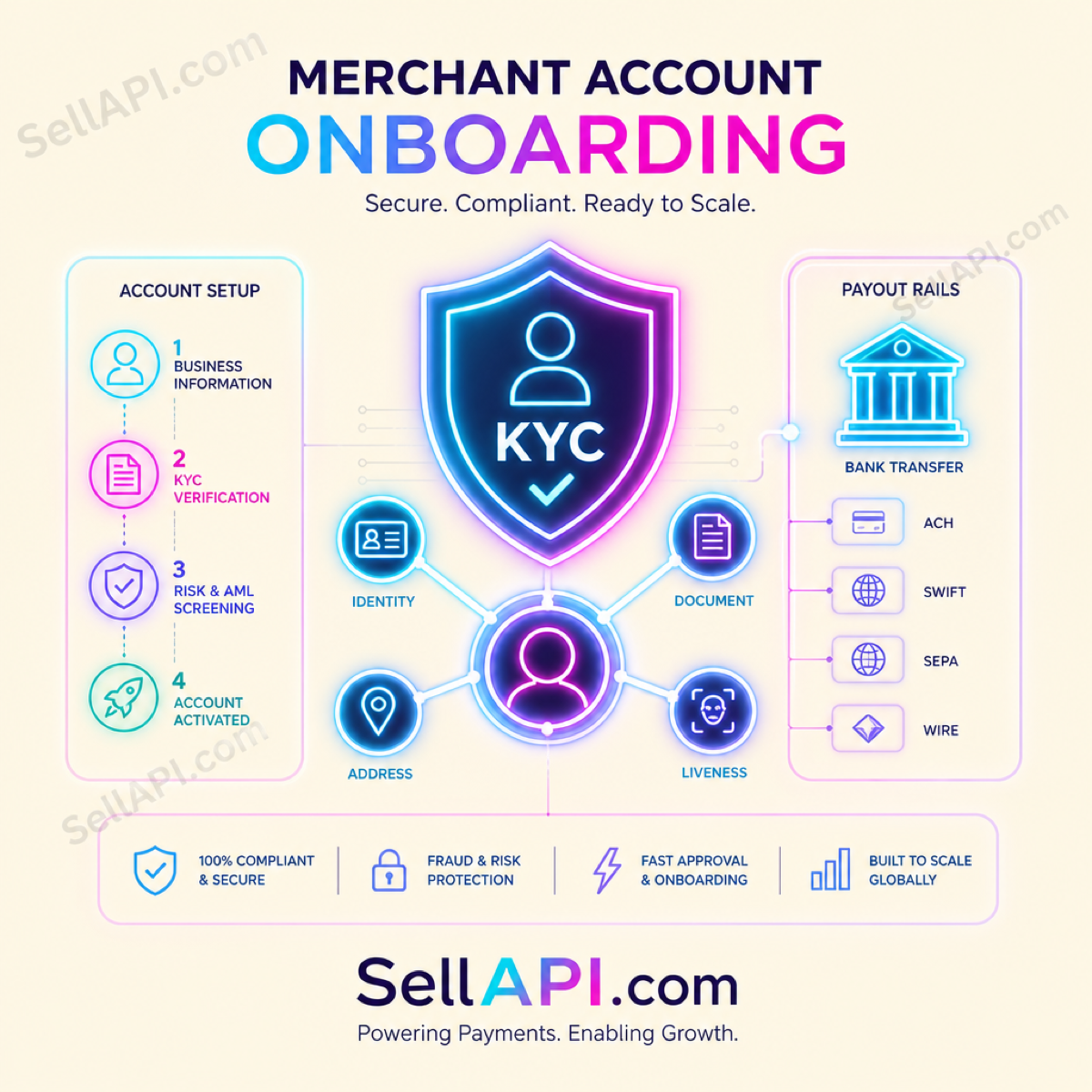
If you are evaluating Merchant Account Sell API in 2026, this guide from SellAPI.com explains practical architecture, compliance touchpoints, and launch steps. You will see how Merchant Account Sell API fits beside Merchant Account Sell API, Marketplace Sell API, Crypto Sell API, Solana Sell API, Ethereum Sell API, and Stablecoin Sell API—without forcing a rewrite.
Merchant Account Sell API in platform context
Platforms that enable sellers need more than a charge API. The Merchant Account Sell API on SellAPI.com creates connected merchant identities, runs KYC/KYB, and attaches payout destinations so each seller can receive funds compliantly.
Compared with forcing every seller onto a shared MoR model, Merchant Account Sell API lets platforms choose liability and experience. Many marketplaces combine it with Marketplace Sell API for fee take rates and automatic splits.
Onboarding quality determines activation. Drop-offs happen when identity forms feel opaque. SellAPI.com encourages progressive KYC: collect minimum data to create a draft merchant, then escalate requirements as volume grows.
KYC, KYB, and risk tiers
Individuals and companies differ. Capture legal name, address, DOB or incorporation data, and beneficial owners where required. The Merchant Account Sell API returns requirement objects so your UI can render the next outstanding field dynamically.
Risk tiers may unlock higher payout velocity after positive history. Surface those milestones in your seller dashboard. Link sellers to PCI and KYC guidance so they understand why documents are requested.
Store only what you need. Prefer hosted document upload when available. Encrypt at rest any residual PII your app mirrors for support workflows.
Payouts and banking details
Bank accounts, debit cards, or local payout rails attach to merchant accounts. Validate account ownership before first payout. Schedule payouts daily, weekly, or manual—product choice depends on seller cash-flow expectations.
Failed payouts must be visible. Listen to payout.failed events via Sell API webhooks and notify sellers with remediation steps. Silent failures destroy trust faster than slow KYC.
Cross-border platforms should preview FX and arrival times. Tie messaging back to SellAPI.com settlement estimates rather than inventing local SLAs.
Embedding onboarding in your product
Hosted onboarding is fastest. Embedded components keep brand control. Fully API-driven flows fit regulated verticals with custom case management. Pick based on engineering capacity and compliance appetite.
After merchants are active, let them create Sales through your platform using the shared Sell API. Your application fee can sit beside their net—detailed in the Marketplace Sell API guide.
Questions about enabling Merchant Account Sell API? Email [email protected] or review pricing for connected account fees.
Governance for platforms
Define acceptable use, prohibited categories, and appeal paths. Sync enforcement actions with SellAPI.com account statuses so suspended merchants cannot charge.
Audit logs should show who changed payout destinations. Require step-up auth for bank updates. These controls belong in your app even when the Merchant Account Sell API handles core identity.
Revisit onboarding conversion monthly. Small copy changes often beat big redesigns when KYC friction is the real bottleneck.
How Merchant Account Sell API connects to the rest of SellAPI.com
Every module shares authentication, metadata, and event envelopes. That means your observability stack instruments one Sell API client. Homepage product pillars link here so visitors researching Merchant Account Sell API land on actionable implementation guidance rather than thin marketing blurbs.
When prioritizing roadmap work, sequence sandbox mastery, then live Selling API charges, then merchant or marketplace complexity, then crypto rails. Teams that invert this order usually rebuild ledgers twice.
Bookmark the SellAPI.com blog index for updates, and subscribe via RSS to catch changelog-adjacent tutorials as they publish throughout 2026.
Implementation anti-patterns to avoid
Do not block HTTP requests waiting on chain finality or payout banks. Do not ignore webhook signatures. Do not reuse idempotency keys across different orders. Do not hardcode fees that belong in Marketplace Sell API parameters.
Do not teach support to “just refund in the dashboard” without ledger adjustments. Do not mix sandbox and live keys in the same environment config. Do not scrape HTML for status—use APIs and events.
Avoid dark patterns in checkout. Clear consent and accurate descriptors reduce disputes, which protects your Merchant Account Sell API standing.
Measurement, SEO, and documentation hygiene
Instrument funnel events named after Sell API objects. Publish internal runbooks with the same vocabulary as public docs. When you write customer-facing help articles, deep-link to SellAPI.com guides such as this one to reinforce topical relevance for Merchant Account Sell API.
On-page, keep a single H1, descriptive H2s, and descriptive image alt text. That Yoast-style discipline helps both humans and crawlers.
Quarterly, audit internal links from homepage anchors to blog posts and back. Broken pathways waste the authority you earn from long-form education.
Additional notes on Merchant Account Sell API
Operators running Merchant Account Sell API on SellAPI.com should continuously refine monitoring, seller communications, and documentation. Align product, finance, and support around the same Sell API objects. Revisit sandbox scenarios after each major release, and keep internal links fresh between the homepage pillars and this article so customers always find the next educational step. Cross-check Marketplace Sell API fees, Merchant Account Sell API statuses, and Crypto Sell API quotes in a single weekly ops review.
Additional notes on Merchant Account Sell API
Operators running Merchant Account Sell API on SellAPI.com should continuously refine monitoring, seller communications, and documentation. Align product, finance, and support around the same Sell API objects. Revisit sandbox scenarios after each major release, and keep internal links fresh between the homepage pillars and this article so customers always find the next educational step. Cross-check Marketplace Sell API fees, Merchant Account Sell API statuses, and Crypto Sell API quotes in a single weekly ops review.
Additional notes on Merchant Account Sell API
Operators running Merchant Account Sell API on SellAPI.com should continuously refine monitoring, seller communications, and documentation. Align product, finance, and support around the same Sell API objects. Revisit sandbox scenarios after each major release, and keep internal links fresh between the homepage pillars and this article so customers always find the next educational step. Cross-check Marketplace Sell API fees, Merchant Account Sell API statuses, and Crypto Sell API quotes in a single weekly ops review.
Additional notes on Merchant Account Sell API
Operators running Merchant Account Sell API on SellAPI.com should continuously refine monitoring, seller communications, and documentation. Align product, finance, and support around the same Sell API objects. Revisit sandbox scenarios after each major release, and keep internal links fresh between the homepage pillars and this article so customers always find the next educational step. Cross-check Marketplace Sell API fees, Merchant Account Sell API statuses, and Crypto Sell API quotes in a single weekly ops review.
Additional notes on Merchant Account Sell API
Operators running Merchant Account Sell API on SellAPI.com should continuously refine monitoring, seller communications, and documentation. Align product, finance, and support around the same Sell API objects. Revisit sandbox scenarios after each major release, and keep internal links fresh between the homepage pillars and this article so customers always find the next educational step. Cross-check Marketplace Sell API fees, Merchant Account Sell API statuses, and Crypto Sell API quotes in a single weekly ops review.
Additional notes on Merchant Account Sell API
Operators running Merchant Account Sell API on SellAPI.com should continuously refine monitoring, seller communications, and documentation. Align product, finance, and support around the same Sell API objects. Revisit sandbox scenarios after each major release, and keep internal links fresh between the homepage pillars and this article so customers always find the next educational step. Cross-check Marketplace Sell API fees, Merchant Account Sell API statuses, and Crypto Sell API quotes in a single weekly ops review.
Keep exploring SellAPI.com
Return to the Sell API products section, review pricing, or contact [email protected].