Sell API Complete Guide: Build Payments That Scale
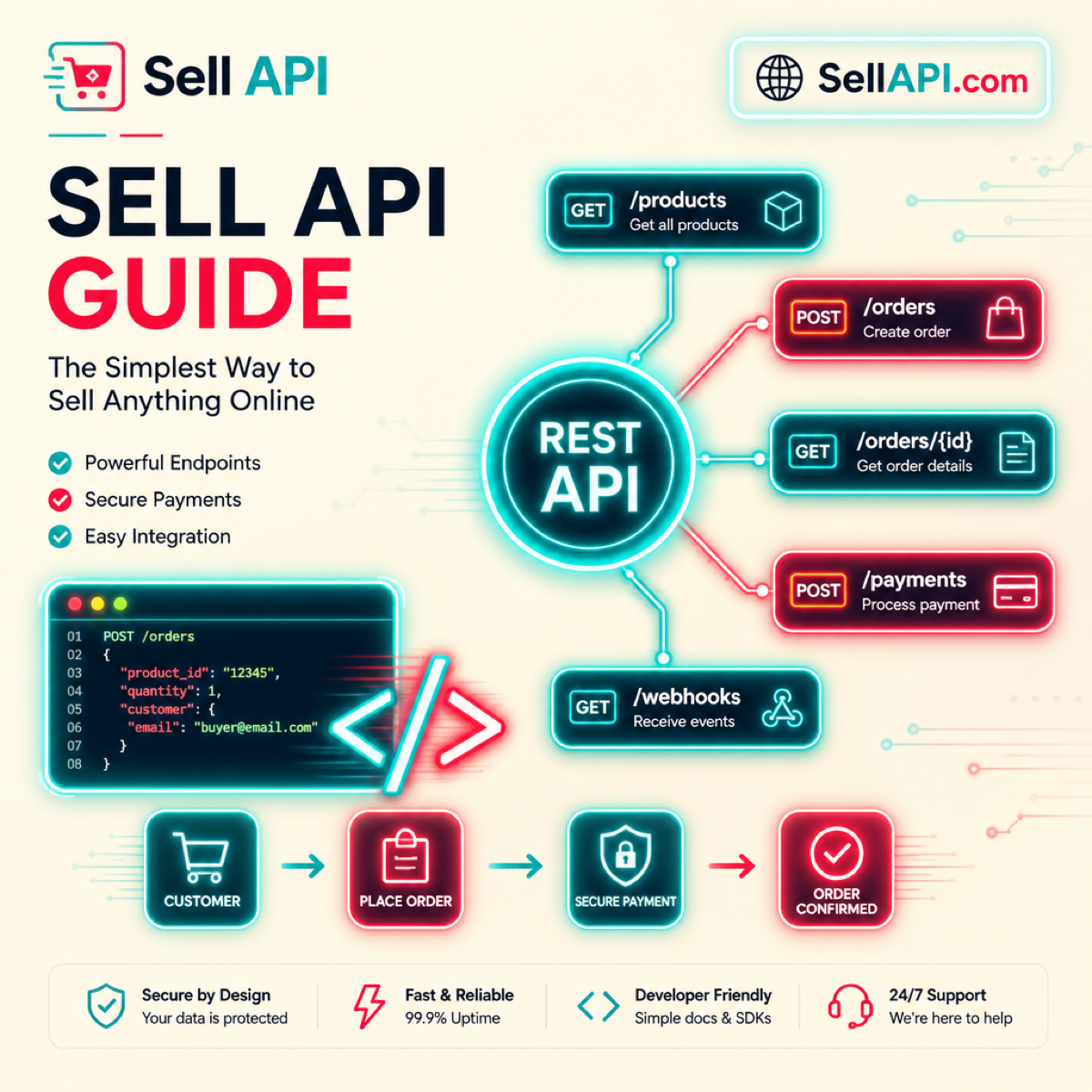
If you are evaluating Sell API in 2026, this guide from SellAPI.com explains practical architecture, compliance touchpoints, and launch steps. You will see how Sell API fits beside Merchant Account Sell API, Marketplace Sell API, Crypto Sell API, Solana Sell API, Ethereum Sell API, and Stablecoin Sell API—without forcing a rewrite.
Why teams choose a dedicated Sell API
A modern Sell API is more than a charge endpoint. On SellAPI.com, the Sell API is the control plane for creating sales, capturing payment methods, coordinating refunds, and emitting settlement events your systems can trust. Product engineers pick a Sell API when they need one vocabulary for cards, marketplace transfers, and crypto sells—without stitching five processors into a fragile custom stack.
Search intent around Sell API and Selling API usually means teams want to accept payments API-style: authenticated requests, idempotent writes, and webhook-driven state. SellAPI.com positions the Sell API as that shared language. Whether you are launching SaaS billing or a multi-vendor cart, starting from a coherent Sell API reduces rework when you later add Merchant Account Sell API onboarding or Marketplace Sell API split payments.
This guide walks through mental models, request shapes, sandbox practice, and production checklists so your first Sell API launch is boring—in the best way. Pair it with our deep dives on the Selling API and Sell API webhooks for operational hardening.
Core objects in the SellAPI.com Sell API
Think in objects: Customers, PaymentMethods, Sales (or PaymentIntents), Transfers, Payouts, and Events. The Sell API keeps these consistent whether the money moves on card rails or via Crypto Sell API. That consistency is what lets one engineering team own checkout today and marketplace fees tomorrow.
Authentication uses restricted API keys scoped to sandbox or live mode. Never embed secret keys in mobile apps; use ephemeral client tokens for collect-and-confirm flows. The Selling API patterns on SellAPI.com assume server-side confirmation for high-risk or high-value sales.
Amounts are integer minor units. Currencies are ISO codes. Metadata bags let you attach order IDs without polluting core schema. When you later enable Marketplace Sell API, the same metadata helps reconcile platform fees and seller net amounts.
Sandbox-first integration path
Create a SellAPI.com account, generate sandbox keys, and place a test sale end-to-end before touching production. Confirm you receive signed webhooks for succeeded, failed, and refunded states. If webhook delivery fails, the Sell API dashboard (and API list endpoints) remain your source of truth.
Exercise edge cases early: insufficient funds, 3-D Secure challenges, partial refunds, and duplicate submissions with the same idempotency key. These drills are cheaper in sandbox than in a war room. Document your retry policy beside the Sell API webhooks reference.
When sandbox green-lights, map monitoring: latency SLOs on create-sale, error budgets on webhook processing, and reconciliation jobs that compare Sell API balances to your ledger nightly.
From first charge to multi-product selling
Day one might be a single-SKU checkout. Day ninety might include Merchant Account Sell API for sub-merchants, Marketplace Sell API application fees, and a Stablecoin Sell API path for USDC settlement. The Sell API is designed so those are additive modules—not a rewrite.
Internal linking tip for SEO and UX: send readers from product pages to this guide, and from this guide back to homepage anchors for Products, How it works, and Security. SellAPI.com wins when every Sell API keyword cluster has a clear next step.
If you need human help, email [email protected]. For commercial questions, review pricing after you estimate monthly sale volume and payout complexity.
Checklist before you go live
Rotate keys, enable webhook signature verification, store only tokens (not PANs), and define dispute playbooks. Align finance on payout calendars if you use Merchant Account Sell API bank destinations.
Publish a status page subscriber list for your stakeholders. Keep OpenAPI snippets in your repo. Schedule a quarterly review of Sell API changelog entries so new fields do not surprise you.
Finally, educate support: they should know the difference between a failed authorization and a delayed settlement webhook. That clarity turns your Sell API into a durable company capability—not a fragile integration.
How Sell API connects to the rest of SellAPI.com
Every module shares authentication, metadata, and event envelopes. That means your observability stack instruments one Sell API client. Homepage product pillars link here so visitors researching Sell API land on actionable implementation guidance rather than thin marketing blurbs.
When prioritizing roadmap work, sequence sandbox mastery, then live Selling API charges, then merchant or marketplace complexity, then crypto rails. Teams that invert this order usually rebuild ledgers twice.
Bookmark the SellAPI.com blog index for updates, and subscribe via RSS to catch changelog-adjacent tutorials as they publish throughout 2026.
Implementation anti-patterns to avoid
Do not block HTTP requests waiting on chain finality or payout banks. Do not ignore webhook signatures. Do not reuse idempotency keys across different orders. Do not hardcode fees that belong in Marketplace Sell API parameters.
Do not teach support to “just refund in the dashboard” without ledger adjustments. Do not mix sandbox and live keys in the same environment config. Do not scrape HTML for status—use APIs and events.
Avoid dark patterns in checkout. Clear consent and accurate descriptors reduce disputes, which protects your Merchant Account Sell API standing.
Measurement, SEO, and documentation hygiene
Instrument funnel events named after Sell API objects. Publish internal runbooks with the same vocabulary as public docs. When you write customer-facing help articles, deep-link to SellAPI.com guides such as this one to reinforce topical relevance for Sell API.
On-page, keep a single H1, descriptive H2s, and descriptive image alt text. That Yoast-style discipline helps both humans and crawlers.
Quarterly, audit internal links from homepage anchors to blog posts and back. Broken pathways waste the authority you earn from long-form education.
Additional notes on Sell API
Operators running Sell API on SellAPI.com should continuously refine monitoring, seller communications, and documentation. Align product, finance, and support around the same Sell API objects. Revisit sandbox scenarios after each major release, and keep internal links fresh between the homepage pillars and this article so customers always find the next educational step. Cross-check Marketplace Sell API fees, Merchant Account Sell API statuses, and Crypto Sell API quotes in a single weekly ops review.
Additional notes on Sell API
Operators running Sell API on SellAPI.com should continuously refine monitoring, seller communications, and documentation. Align product, finance, and support around the same Sell API objects. Revisit sandbox scenarios after each major release, and keep internal links fresh between the homepage pillars and this article so customers always find the next educational step. Cross-check Marketplace Sell API fees, Merchant Account Sell API statuses, and Crypto Sell API quotes in a single weekly ops review.
Additional notes on Sell API
Operators running Sell API on SellAPI.com should continuously refine monitoring, seller communications, and documentation. Align product, finance, and support around the same Sell API objects. Revisit sandbox scenarios after each major release, and keep internal links fresh between the homepage pillars and this article so customers always find the next educational step. Cross-check Marketplace Sell API fees, Merchant Account Sell API statuses, and Crypto Sell API quotes in a single weekly ops review.
Additional notes on Sell API
Operators running Sell API on SellAPI.com should continuously refine monitoring, seller communications, and documentation. Align product, finance, and support around the same Sell API objects. Revisit sandbox scenarios after each major release, and keep internal links fresh between the homepage pillars and this article so customers always find the next educational step. Cross-check Marketplace Sell API fees, Merchant Account Sell API statuses, and Crypto Sell API quotes in a single weekly ops review.
Keep exploring SellAPI.com
Return to the Sell API products section, review pricing, or contact [email protected].